
The Great Misallocation
How Germany trapped its capital and talent in the 20th century

TL;DR
Germany’s core economic problem is that too much capital and talent is trapped in legacy businesses with no plan for the future. In its current form, the “social market economy” systematically blocks channels for radical and decisive course correction, such as restructuring companies or making bold strategic investments. The result is a country stuck in a state of toxic loyalty to its 20th-century economy.
The fix: Revive EXIT — the ability to shut down failing initiatives and reallocate talent and capital to productive initiatives — as part of the social contract. Germany — and frankly Europe — must relearn their capacity for radical course correction.
Reverse Culture Shock
WTF happened to my country?!
Two years ago, I moved back to Germany from the US. Although it has been great to be back and to reconnect with friends and family, I also experienced a severe reverse culture shock that lasted well over a year.
The country I grew up in, one that provided me with many opportunities, great education and a sense of forward momentum, suddenly felt extremely stuck. And more shockingly, incapable of breaking out of its own stagnation. This observation remains true today.
I’m certainly not alone with this feeling. Reading the news, just chatting with fellow citizens about day-to-day life, one encounters severe levels of cynicism and pessimism. The future feels bleak.
Germans today feel uncomfortably comfortable. Life is still pretty good. We travel more than ever. Most infrastructure still works. But Zukunftsangst, fear of the future, is a real thing.
The typical story of how we got here is this one: We relied on cheap energy from Russia and exported heavily, especially cars, to China. This worked extremely well, until it didn’t. Our Chancellor Friedrich Merz seems to believe it’s a lack of work ethic that is holding us back. The Chinese simply work harder than us. While the data confirms that Germans are not the hardest working people[1], Merz entirely misunderstands our problem. More on that later.
My suspicion is that Germany’s — and frankly Europe’s — problems run deeper than this simple economic story or a lack of work ethic. Unless we address those, I argue, we won’t get out of this mess.
Exit, Voice & Germany
What Albert Hirschman teaches us about our decline
I recently reread Albert Hirschman’s classic Exit, Voice and Loyalty.[2] The book provides a simple yet powerful mental model for understanding how individuals, firms and societies respond when things start to go wrong.
Put differently, the book is great to assess the kind of situation Germany is in right now: Things are okay-ish, but the trajectory is concerning.
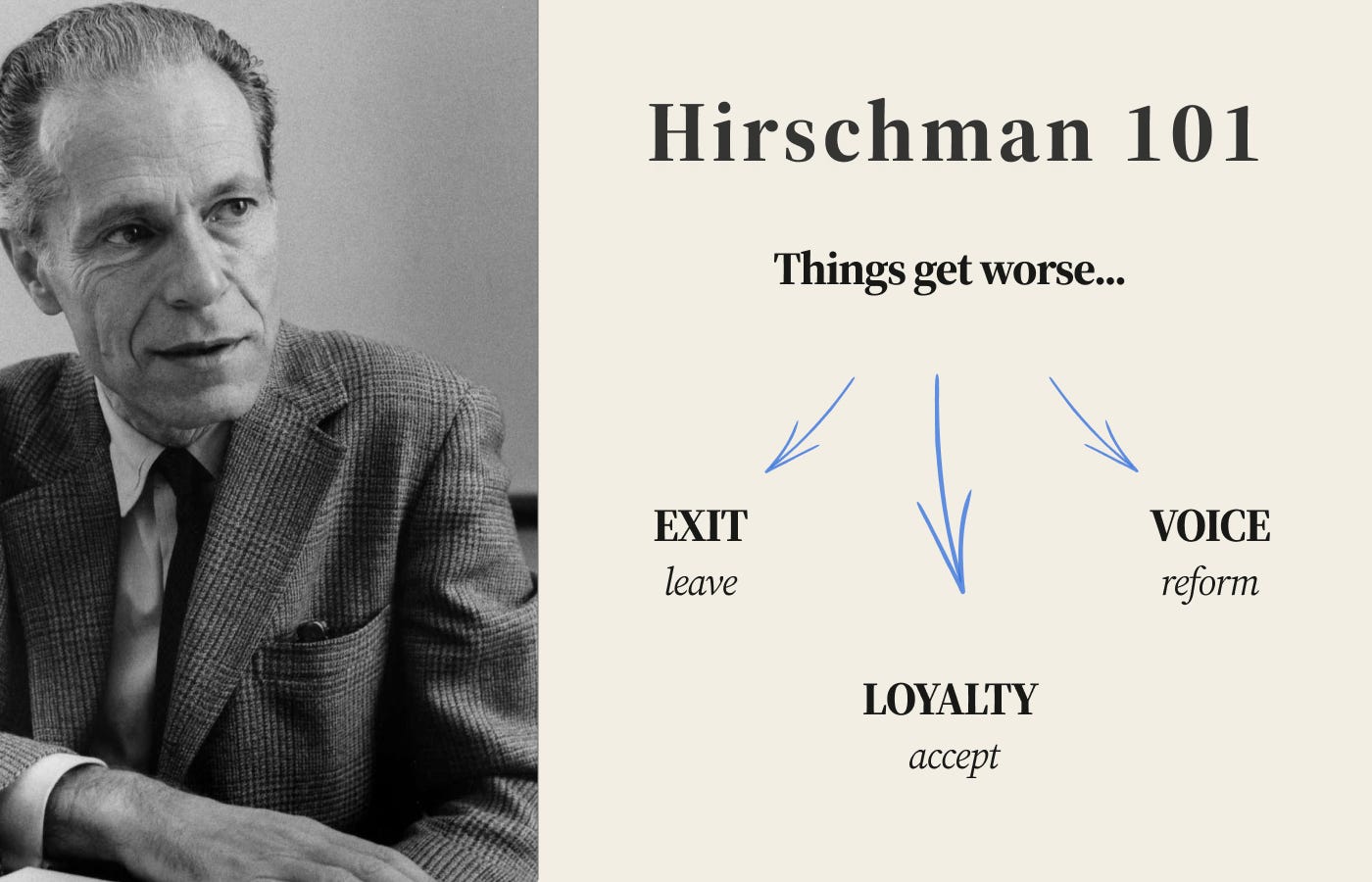
Hirschman’s intuition is straightforward. When quality deteriorates, whether of a product, an institution, or a system, there are two primary responses (EXIT, VOICE) and one modifying factor (LOYALTY).
EXIT. You leave. You switch providers, shut something down, or move on. EXIT works through markets and competition.
VOICE. You complain. You protest, negotiate, vote, and attempt to reform from within. VOICE works through politics.
LOYALTY is an in-between state. In moderation, it buys time to adjust and get back on track. But when LOYALTY becomes the default, it turns toxic. There is a longing for change, but nothing fundamentally happens.
My core thesis is that in Germany, and again much of Europe, EXIT as a mode of change is deeply broken. (Interestingly, the precise opposite seems to be true for the US, i.e. VOICE is deeply broken, but that’s a different essay.)
I use EXIT here in a broad sense: It is the ability to make radical decisions when decline is persistent. To shut things down. To allow organizations, policies, and business models to end so that something else can take their place. EXIT can be harsh, but it is not per se reckless. It is, however, the precondition for renewal.
I believe our society is no longer capable of performing EXIT. It is simply incapable of saying “enough is enough”. EXIT in Germany is possible in theory, but way too often it is a non-credible threat. EXIT happens, but almost always when it’s too late.
As a result, too much German capital and talent is systematically trapped in businesses with no plan for the future. Leaders have no incentive to pursue radical transformation. Laws and governance structures are designed to preserve the status quo at all costs.
In any healthy system, Hirschman stresses, EXIT is as essential as VOICE and LOYALTY. When EXIT is suppressed, VOICE as a mechanism for change loses credibility. Complaints go unheard because nothing fundamental is allowed to change in any case. LOYALTY, meanwhile, turns into a mix of resignation and frustration.
This is, I argue, where Germany stands today: In a perpetual state of toxic LOYALTY to a 20th century economy.
The Hidden Flaws of the Social Market Economy
How Germany’s obsession with stability became its biggest trap
A backbone of the German model is the idea of the “Social Market Economy”, i.e. the idea of combining the dynamism of the free market with a strong government and social protection. There is an inherent conflict in this model, but it’s one worth fighting for.
It’s the recognition that capitalism has been the best engine for progress, innovation and wealth accumulation. But it’s also the pushback that such a system left on its own creates social tensions and unfairness.
This model proved to be incredibly successful post-World War II. Germany had a great boom (“Wirtschaftswunder”), became one of the biggest economies in the world, but those gains didn’t only accumulate with shareholders — workers had decent lives as well.
Looking back, Germany created an unbelievable amount of wealth for a country that caused World War II. Germany had its fair share of hiccups: the most recent one, the early 2000s when the country was labeled the “sick man of Europe”.[3] While still controversial today, Germany reacted with a decisive reform called “Agenda 2010” to counter the decline.[4]
Germany’s strength is its world-class engineering culture and tightly knit ecosystem built around industrial technologies. It’s mostly the “hidden champions” of the Mittelstand and the automotive sector that define the soul of the German economy. Germany became known for efficiency, premium quality and continuous improvement. “Made in Germany” as a brand reflected precisely that.
The German model created stability and wealth. Thus, the thinking became stability creates wealth. In practice this meant long product cycles, incremental innovation, patient capital, strong labor protections, worker representation in the supervisory board and close relationships between firms, banks, and the state.
This structure of our economy has many benefits but one fundamental flaw that is becoming shockingly clear over the past couple of years.
The German model works great if there is no disruptive change in technology. But it seems entirely helpless if there is.
The hidden downside of the institutional focus on continuity and stability was that EXIT was quietly suppressed.
However, if the underlying technological infrastructure of our economy is radically changing, businesses need to adjust through reallocation of capital and talent. This process, I argue, is systematically blocked.
Meaning Well, Causing Harm
How policies preserve the status quo at all costs
So how exactly is EXIT suppressed in Germany? I give you three examples that I believe to be critical. There are certainly more.
1) Labor Protection Laws: The hidden blocker to innovation
In Germany, laying off people is not a business decision but a legal project. By default, most white-collar workers have permanent contracts. You can’t lay them off unless there is a strong reason (e.g. personal misconduct, poor financial performance of the company). Arguing that an industry is rapidly changing and a different operational setup is needed is generally not considered sufficient.
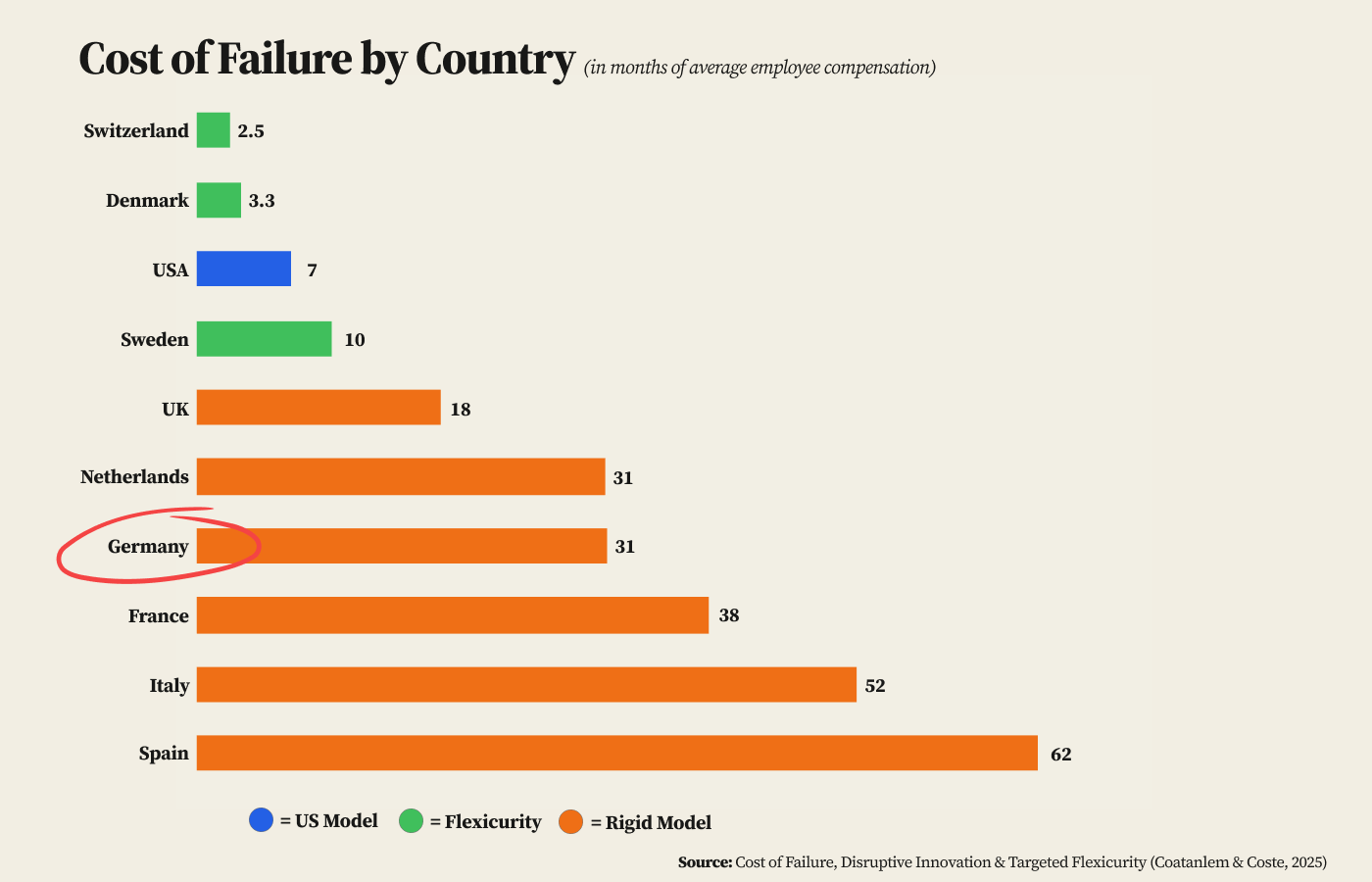
If a company chooses to lay off employees, it requires massive management attention. The process needs to follow specific social criteria and is expensive (mandatory severance packages, legal costs, etc.). Put differently: the cost of failure is extremely high.
Recently, a study confirmed that the extensive labor protection throughout Europe prevents corporates from making large strategic bets — the kind of strategic bets that are much needed in a technologically driven world. Potential restructuring costs in case of failure of such a high-risk, high-reward project are simply too high for management to take that risk in the first place.
The authors of the study calculated a weighted average of 31 months of gross salary as severance for large-scale restructuring plans in Germany between 2020 and 2024. Multiply that by a couple of thousand employees that may be affected by a restructuring, and you get a sense why corporates become so slow-moving.[5]
Another consequence of strong labor protection is its effect on corporate culture. Implicitly, employees experience high switching costs once they join a firm and stay for a few years. Leaving a safe and heavily protected corporate job seems risky.
On the flip side, the low probability of losing a job may also reduce incentives to stay on top of the latest trends in one’s field — a point Friedrich Merz may not be entirely wrong about.
2) Codetermination: The weaponization of VOICE to block EXIT
Germany is often praised for the representation of workers on the supervisory board. For companies with more than 2,000 employees, 50% of the board seats represent employees, 50% represent shareholders. If there is a tie in the vote, the chair of the board, representing shareholders, has an additional decisive vote.[6]
Having the workers’ perspective at the decision-making table is a great way to ensure that benefits are accruing broadly throughout the entire community. However, there is a hidden cost to this setup: When management determines that a radical transformation is needed to stay competitive, the people who would bear the cost of EXIT sit at the same table and have the institutional power to defer change in the supervisory board.
This is Hirschman’s point inverted: VOICE is supposed to be the alternative to EXIT. But in Germany, VOICE can be weaponized to block or at least heavily delay EXIT.
As mentioned above, theoretically the supervisory board ultimately represents the shareholders, but given board seats are almost at perfect parity for large organizations, it takes a long time to turn insight into action. Change happens — EXIT always finds its way — but too often, it’s too late and too little.
3) Broken Banking: A financial system designed to preserve the past
Germany’s banking system is structurally designed to keep capital where it already is.
On one side: The country has one of the most fragmented banking ecosystems in the world. Many local SMEs borrow from their local Sparkassen (municipality owned banks) or Volksbanken (cooperative banks) with strong ties to the local economy. In the case of Sparkassen, local politicians are often on the supervisory board.
When a firm struggles, the political incentive is obvious: extend credit, restructure the debt, and keep the business alive at all costs. More than a private bank, the incentive of Sparkassen is to prevent EXIT. To be fair, the literature on the extent to which the German banking system produces zombie firms is mixed; and it is difficult to prove my point with data.
What I want to convey is a feeling: the German banking ecosystem through its fragmentation and regional footprint breeds financial conservatism and risk-aversion. Too much capital, the deposits of tens of millions of Germans, is trapped on balance sheets of bankers with a bias for preservation. While it’s not their job to fund the highest-risk ventures, they are crucial when it comes to our culture and thinking around money.
On the other side: The near absence of venture capital, particularly when it comes to growth capital. Venture capital is the financial expression of EXIT: it funds the new by betting against the old. A global economy that is so heavily dominated by technological disruption requires capital markets that lean on the side of making large strategic bets with non-linear payoffs. Venture capital in Germany and Europe (0.2 percent of GDP) is significantly lower than in the US (0.7 percent of GDP).[7]
Venture capital is a long-term game. The tech companies that dominate the world economy today all benefitted from a much stronger venture capital industry in the US.
The German banking system is getting it wrong on both ends. Bluntly speaking: the “Hausbank” keeps zombies alive, the lack of venture capital confirms there is little to replace them with.
Creative Destruction ≠ Deregulation
The social contract needs EXIT to function
At this point of the essay, an important disclaimer is needed: I’m not making the case for deregulating all aspects of the economy. What I’m arguing, however, is that Germany needs a model of a social market economy that doesn’t suppress EXIT at every level and treats it by default as the “evil” option. EXIT is supposed to be an inherent part of the social contract.
The global economy is changing fast through technology. Disruptive innovation — the very manifestation of EXIT — has become at least as important as incremental innovation.
While the world around us is changing rapidly, we cannot afford to have capital and talent trapped in 20th century businesses. Transforming those industrial champions is already difficult enough. Depriving them of tools to even attempt this is a recipe for continued decline.
Volkswagen: A Tale of Toxic LOYALTY
Germany’s symbolic brand is a poster child for the lack of EXIT
One of Germany’s most prized brands is arguably Volkswagen, a company that symbolizes the ascent of the German economy post-World War II despite its dark origins. With plenty of incremental innovation in fuel-based engines, consolidation of many of the most iconic car brands in the world, and a strong export emphasis (i.e. China), Volkswagen became one of the world’s leading automotive companies.
The peak of Volkswagen was arguably just before COVID hit. Volkswagen sold over 4 million cars in China[8], the stock was nearly at an all-time high. But whereas most stocks recovered quickly during COVID, Volkswagen never got back on track. The reason: The structural decline happened already a long time ago; COVID was simply an accelerator.
Volkswagen benefiting during the first two decades of globalization in the 21st century was still a spillover effect from the 20th century. China still had to catch up and relied heavily on companies such as Volkswagen to do so. Also, both the digital and EV revolutions still needed a few years before hitting their exponential inflection point.
Today, we see Volkswagen struggling on all fronts and for the first time in its history announcing the closure of factories in Germany.[9]
Dealing with technological disruption is a serious challenge for any company. However, I believe the story runs deeper than the typical innovator’s dilemma.
Do I believe Volkswagen had the right management? No. Do I believe a founder-like personality would have fixed the problem? Most likely not.
But I do believe the story of Volkswagen highlights that a lack of EXIT meant that the company may never have had a real chance.
There were attempts that resembled EXIT. Corporate innovation units, mobility bets, software subsidiaries: WeShare, the GETT investment, MOIA, CARIAD, Northvolt, Argo AI. But none of them were allowed to fundamentally challenge or cannibalize the core business.
They were all pursued half-heartedly to please investors. A form of innovation theater while the focus was on exporting fuel-based vehicles to China. Pursuing actual and painful transformation, however, was structurally suppressed on many levels.
Volkswagen has an unusual supervisory board structure for a global automotive champion. The 20-member board is split evenly: ten employee representatives (workforce and trade union officials) and ten shareholder representatives. Two of the shareholder seats belong to the state of Lower Saxony, which holds about 20% of the voting rights and thus a blocking minority.[10]
The stakeholder governance has undoubtedly its benefits, but this board configuration is not ideal if you want to navigate an industry going through technological disruption. You won’t sign off on investing in the large-scale automation of factories if you represent thousands of workers. You delay investing in EVs if building those requires a different skillset and generally requires less of a workforce.
As Hirschman writes, a lack of EXIT leads to adverse effects. One of them is that LOYALTY potentially turns toxic. This may be a leap for some readers, but I believe Dieselgate[11] — the manipulation of emission data that led to a worldwide scandal costing Volkswagen billions of dollars — is at least partly a manifestation of toxic LOYALTY.
There was no confidence in any other future than a continuation of the past. Preserving the status quo became such an imperative that managers committed crimes. Crime was arguably cheaper and easier than transformation.
Officially, neither the politicians nor the unions had any knowledge of the manipulation. However, I do wonder how they would have reacted if they had known.
Simply Working Harder Doesn’t Cut It
Why Friedrich Merz is getting it wrong
A recent obsession of Chancellor Friedrich Merz is to criticize Germans for their work ethic. He argues that the country won’t fix the economy if Germans continue to pursue what he calls “Lifestyle-Teilzeit”, i.e. people working part time to enjoy work-life balance.[12]
Merz reemphasized this point after recently returning from China, where the government demonstrated its impressive robotic capabilities. The business community applauds when Merz addresses the work ethic. And there is some truth: By OECD standards, Germans work the fewest hours.
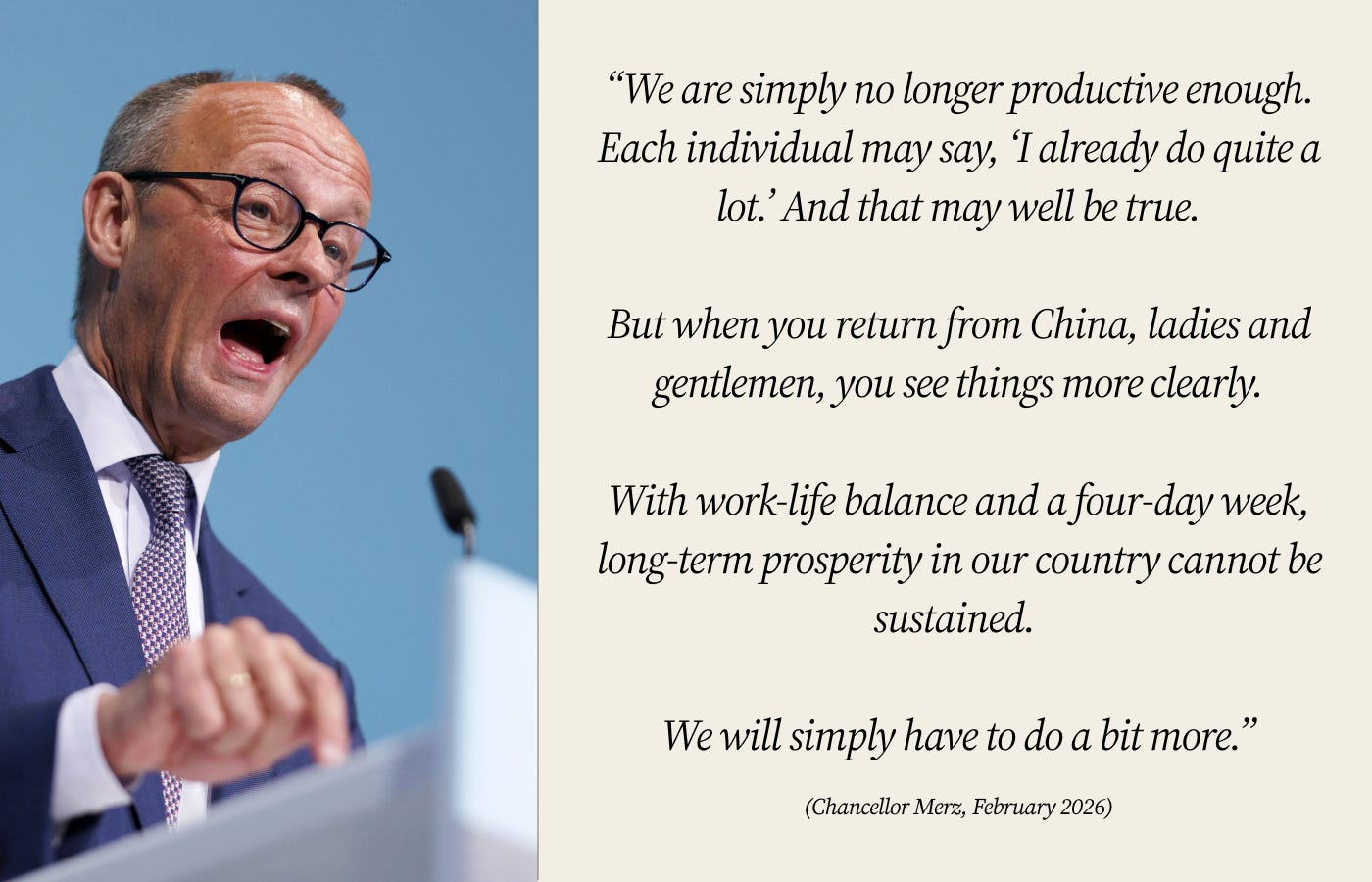
However, Merz deflects from the real problem: Yes, Germans do not work particularly hard. But more problematically: Most Germans work on the wrong thing. How many hours they work may have a short-term impact on GDP and tax collection. But it makes no difference to our overall productivity and future wealth of the country.
My point is: For many corporate jobs in Germany, it makes little difference to the performance of the company, let alone the competitiveness of our economy, whether the people work one day or five days a week. While this seems to be a pattern across the corporate world in developed economies (i.e. the phenomenon of “Bullshit Jobs”[13]), the difference is that our current institutional setup ensures these jobs are as protected as possible.
The actual problem of Germany is that we have too few companies that work on things that matter from an innovation point-of-view. And I can assure Friedrich Merz that within those few innovative startups and scaleups people do work overtime.
Germany’s economic problem at this moment is primarily a restructuring and misallocation problem. Talent and capital are stuck in the wrong place, and markets can’t do their job — this is primarily a political problem, not a mindset problem.
If Merz wants to contribute to a solution he needs to radically bring down the restructuring costs in our economy by addressing the mix of laws, norms and culture preventing change. This, however, is politically much more costly than raging against a lack of work ethic.
Germany needs more exposure to frontier technological change through vastly increasing the number of innovative companies. This is the only way out of the current stagnation. There is no quick fix. This is a long-term play that requires at least a decade and a half to play out (think of it as the cycle of one large venture capital fund).
This will only be possible if we give EXIT in our economy the space it deserves.
Germany’s Marshmallow Test
Can Germany accept short-term pain for long-term benefits?
Again, the point of this essay is not to abolish the ideal of the social market economy – it is about reemphasizing the idea of EXIT. However, the first years of strengthening EXIT will certainly feel like a strong deregulation shift.
Germany currently engages in perpetual pain avoidance, which is partly an unsurprising consequence of a democracy with an increasingly old population. Many white-collar workers in their 40s, 50s and 60s bought into the current setup of the social market economy. For them, a politics that would reemphasize EXIT is indeed threatening. However, for all their fear, they should consider the future they leave behind for their children and grandchildren.
A system that prevents EXIT and lives off past successes can last longer than one might expect. But ultimately the system becomes so broken that it starts cracking. That pain will be brutal, because the system continues to double down on old habits to fix the problem (i.e. toxic LOYALTY). One could take the recent comeback of the political debate around the ban on fuel-based vehicles as an example of that.
However, as any doctor would tell you, pain avoidance makes things worse. The earlier we engage in structural change, the better we will be prepared for the future.
This piece is not intended to go into a full list of policy recommendations but from a high-level perspective, EXIT can be strengthened in two dimensions.
Dimension 1: Reduce status quo protection
EXIT needs to be made credible again.
Reform labor protection towards “flexicurity”: Protect people, not jobs. Government’s role is to support in reallocation after restructuring, not to prevent it in the first place.
Reform codetermination for strategic pivots: Allow companies to take quick & decisive action when technology-driven transformation is at stake.
Establish clear sunset clauses for subsidies: “Kurzarbeit” (program for wage subsidies) and industry subsidies should have built-in expiration dates. Temporary help cannot become permanent life support.
Address insolvency culture: Debt and guilt are the same word in German (“Schuld”). The procedures and stigma around failure create a cultural barrier to EXIT.
Dimension 2: Build towards the future
EXIT needs to be encouraged.
Scale public venture capital 10x: KfW capital, SPRIND, WIN Initiative and similar vehicles need to move from peripheral experiments to central economic policy. For every 1€ in subsidy, we should ask: “Is it going towards preserving the past or building the future?”
Reform government procurement: Mandate that a percentage of public procurement (e.g. in defense) goes to technology startups rather than legacy vendors and consulting firms.
Teach Germans money: Germans hold ~€3 trillion in near-zero-return savings accounts.[14] The goal needs to be to redirect preservation capital toward productive investment at scale (e.g. “Aktienkultur”).
Make universities part of the startup infrastructure: Germany has world-class universities but the link to the private sector is still in its early days, with notable exceptions, such as TUM or WHU. Scale proven models countrywide.
Again, these examples are only a tiny taste of how we could address the lack of EXIT in our economy across these two dimensions — and the devil is of course in the details.
The broader point of this blogpost is twofold. First — and I hope this has become clear — EXIT matters, yet it is deeply broken in our economy. Second, fixing it requires action on both ends: reducing the incentives and structures that protect the status quo, while creating new incentives and structures that encourage building for the future. The two go hand in hand.
EXIT always happens…
What kind of EXIT do Germans want?
When I lived in New York, I strongly considered applying for the Greencard and staying. For those interested in working on frontier problems and a dynamic environment, the US remains the place to be.
But the US system has many social tradeoffs that I didn’t want to live with. I believe there must be a middle ground, and that is the purpose of this blogpost.
Germans and Europeans are waking up to a different world order with greater degrees of uncertainty and ambiguity, compounded by the onset of artificial intelligence. This is scary. The typical response to fear is to go back to what you are already good at and to just work harder. This is precisely the wrong strategy.
Germany needs to take its undoubtedly great assets and embrace the uncertainty of building towards the future.
While you can always suppress EXIT in any given system, EXIT will find its way through different channels. Great talent may vote with their feet and build companies in environments that are more conducive to their ambitions. People, frustrated by stagnation and scared of the future, may vote for more radical parties that promise a different path (*BR-EXIT*).
The smarter way out: Even if it is painful, it should be all of us using our VOICE to strengthen EXIT.
[1] Average annual hours actually worked per worker, OECD
[2] Exit, Voice & Loyalty, Albert O. Hirschman
[3] Germany – the sick man of Europe?
[5] Coatanlem, Yann, and Oliver Coste. Cost of Failure, Disruptive Innovation and Targeted Flexicurity: more evidence supporting targeted reforms.
[7] Arnold, Mr Nathaniel G., Guillaume Claveres, and Jan Frie. Stepping up venture capital to finance innovation in Europe. International Monetary Fund, 2024.
[8] Volkswagen China Annual Report 2019
[9] Volkswagen shuts down factory in Germany for the first time in 88 years, GMK
[10] Volkswagen Supervisory Board (2026)
[11] Volkswagen: The scandal explained, BBC
[12] Merz Speech Volksmarsen (February 2026)
[13] Bullshit Jobs, David Graeber
[14] Even the Savings Account Plays Its Part, ifo Institute