
Permanent Beta Anxiety
Why Adopting AI Feels Both Necessary and Pointless

Following technology has recently become a strange, somewhat disappointing experience: the more you engage with new tools and releases, the less caught up you feel.
It used to be that learning specific tools and adopting workflows would ultimately pay off; now it often feels like you only need to wait another two weeks for Anthropic or OpenAI to incorporate the capability directly into the chat interface.
Historically, learning new skills or tools was not only a way to hedge your economic future, but it also provided a stable identity and a feeling of competence. Now it seems like the industry is pushing a huge “reset” button every other day. You never feel good enough or up to date.

The cycles have become extremely short. In LLMs, there now seems to be no week without a new model from Anthropic or OpenAI pushing benchmarks — or an open-source model from China dramatically lowering costs.
Tech announcements are known to exaggerate, but with release cycles this short, excitement turns into a feeling of permanently being behind. Just last week, tech influencer Theo posted two videos on the same day titled “Opus 4.6 Is The Best Coding Model Ever Made” and “Never Mind (OpenAI won again)”.

Even the tech community on X struggles to absorb new releases and keep workflows stable for a single week.
This is not an argument against technological progress, but an observation that even leading tech figures are struggling to keep up. A few weeks ago, Andrej Karpathy tweeted this:
“I’ve never felt this much behind as a programmer. The profession is being dramatically refactored as the bits contributed by the programmer are increasingly sparse and between. I have a sense that I could be 10X more powerful if I just properly string together what has become available over the last ~year and a failure to claim the boost feels decidedly like skill issue.”
If even he struggles to absorb the pace of change, how are the rest of us supposed to deal with it?
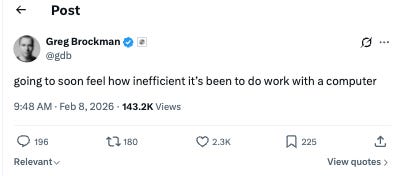
It feels like a dilemma: everybody tells you to engage deeply with AI, yet any serious effort you undertake is invalidated by the next model release.
You engage with the technology, you adopt workflows, you configure your setup, and then suddenly the next iteration commoditizes your work. Everything is suddenly available through a chat interface and new agentic capabilities.
There is a large gap between AI marketing and the psychology of even the people building the technology. The coding assistants and vibe coding platforms of the world use powerful language to convince you to become a builder (which is great).
At the same time, I see many tweets from tech leaders that sound oddly hollow, as if they are trying to convince themselves to remain tech-positive.

I believe we have entered the age of permanent beta anxiety: every skill or form of differentiation is immediately threatened by commoditization, with real psychological consequences across the workforce.
Job replacement by AI is an economic problem; technology constantly invalidating your unique competence is an attack on your identity. Never before have cycles been this fast: adopting new technology feels both necessary and pointless at the same time.